Recipes

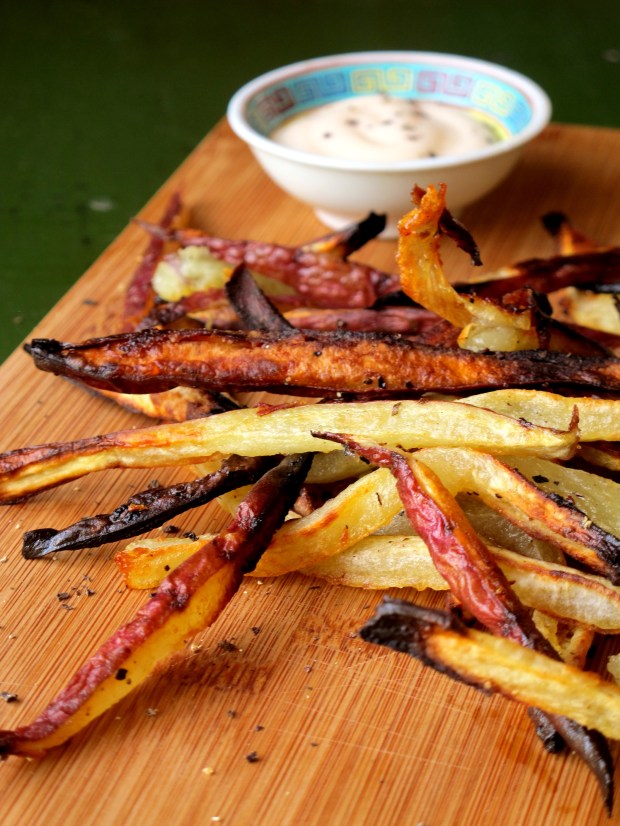
Skinny Sweet Potato “Fries”

Undoubtedly the best thing to come out of my recent flirtations with the Banting lifestyle is a renewed love affair with sweet potatoes.

I’ve always been fond of sweet potatoes, but they have never really been a major part of my diet. These days, however, I can’t seem to live without them. Whilst still a carbohydrate, luckily sweet potato finds itself on the Banting Orange List, making it the “occasional carb” of choice for many of us on LCHF diets. Provided they are eaten in moderation, this tuberous gem is nutritious, tasty and most importantly, relatively guilt-free. Chock full of goodness, sweet potatoes are high in Vitamins A, B6 and C, beta-carotene, potassium, antioxidants and contain enough dietary fibre to account for 16% of your RDA. That’s a lot of ‘goodness’ packed into a humble root vegetable!

The nutritional value of sweet potatoes aside, what ultimately makes them so popular is their versatility; they can be used to make soup, mashed, microwaved, oven-roasted, gratinéed or glazed, although the latter is most definitely not for those of us avoiding sugar! Currently, however, my favourite way of preparing sweet potatoes is to use them to make skinny fries.

Cooked in a hot oven, skinny sweet potato fries are just the absolute bomb. Easy to make, healthy and incredibly tasty, these skinny fries are downright irresistible, making them almost TOO good! Personally, I prefer skinny fries over making sweet potato wedges as their ‘skinniness’ encourages a light singeing of the edges, resulting in a ‘burnt’ bitterness that perfectly plays against the inherent sweetness and earthy tones of the vegetable.

Trust me, wholesome has never tasted this good.

Click here for the recipe

Aloo Mutter (Peas & Potato Curry)

I’m not sure many people can say this, but I owe my sanity to aloo mutter…or at least my sanity in India anyway.

Travel has always been a huge part of our lives. From Tokyo to Kathmandu, down to Ushuaia and all the way back up to Kirkenes, we are blessed to have trampled the globe together. For me our travels have always been synonymous with seeking out new food experiences. For my flavourphobic partner, however, the mere notion of culinary-tourism is unpalatable. In spite of being the most well travelled person I’ve ever met, my partner holds scant regard for sampling foreign flavours in foreign climes. This is, after all, a man who ate nowt but Big Macs in Beijing, Whoopers in Bergen, doner kebabs in Florence…and then there was India.

Ah, dear Mother India!

A land defined by fierce fragrances, earthy hygiene and spicy flavours; India is a culinary destination that should strike fear in the hearts of even the bravest of world travelers, let alone those of limited culinary bravado i.e. ‘you know who’…or so you would think. Little did I know that, culinarily speaking, the sub-continent would prove to be one place in the world the Flavourphobe would have no problem finding something to eat – all thanks to aloo mutter! Who knew a man could almost exclusively live on peas and potatoes for a month, but that he did. With the exception of the occasional aloo gobi, he had it in the South, he had it in the North, he even had it somewhere in the middle and he loved it every single time…but not as much as I did! No one was happier than I when we saw aloo mutter on the evening’s menu; not because I wanted to eat it myself, but rather because it meant we could actually enjoy a meal together whilst on holiday! For the first time on our travels I had been spared our usual dinner-time routine of depositing him at the nearest KFC whilst I sampled the local delights on my lonesome. At last, we could eat at the same restaurant every day. What travel bliss! Indeed what a privilege!

So did aloo mutter prove to be that watershed moment when he would finally open his taste buds to the favours of the world? Hah, don’t make me laugh. With the exception of Japanese Curry, his culinary ‘awakening’ was as short-lived as our time in India. Soon enough we were back to traveling together, but eating apart. Alas, the dream couldn’t last forever and the aloo mutter bubble had to burst at some stage. We will, however, always have dear Mother India and the days she granted us the simple pleasure of  enjoying a meal, together.

Oh…did I forget to mention that aloo mutter is also incredibly delicious and cheap to make? Don’t just take my partner’s word for it, it really is possibly the best way to jazz up a couple of potatoes and those long-forgotten peas at the back of the freezer! Aloo mutter is definitely a worthy addition to any Indian meal.

For more of my top picks for an Indian feast, please click here, or for more great Indian recipes from The Muddled Pantry, please click here

Click here for the recipe

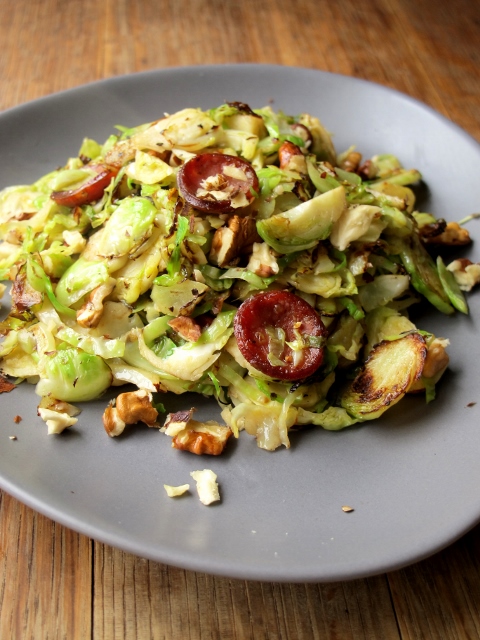
Shredded Brussels Sprouts with Chorizo & Walnuts

Like most food bloggers, I am not without the occasional food obsession. Between walnuts, curly kale, kimchi and an alarming appetite for Peppermint Crisps, my obsessions of choice are as varied as they are peculiar. Currently, however, I can’t seem to get enough of brussels sprouts, so much so, I’ve taken to eating them by the veritable fistful. Thankfully, however,  this particular obsession is one of my healthier food fixations.

Widely regarded as one of the healthiest vegetables you can eat, brussels sprouts are packed full of nutrients (especially Vitamins C & K), protein and dietary fiber. Banting approved and suitable for those of us who are slaves to the LCHF lifestyle, ‘sprout are even reputed to have cancer busting properties. What more could you ask of the humble ‘sprout? Oh, and they just so happen to taste bloody amazing too!

However, all that said brussels sprouts nevertheless remain a hard-sell.

Bitter and cabbage-like, unfortunately ‘sprouts have always suffered from a bad rep. What, however, is the root of our collective loathing of this much maligned wonder-food? As with almost everything in life, you can probably blame your parents. Most of us bear the childhood scars of being force-feed our greens by well-meaning parents and (with perhaps the exception of the dreaded broccoli) arguably the most detested vegetable was the poor brussels sprout. When most of us think about the ‘sprouts of our youth, we remember them as part of a typical Sunday roast, invariably boiled to within an inch of disintegration. Is it any wonder most of us smothered them in gravy or fed them to the dog on the sly! Sadly, never has such a noble vegetable been treated so poorly and by so many. Whilst many of us remain understandably traumatised by our early experiences, I have actually come to enjoy boiled ‘sprouts and they are almost always part of my roast dinners. More recently, however, I’ve taken to sautéing my ‘sprouts and I have never looked back!

Quick, tasty and incredibly healthy, shredding and sautéing your ‘sprouts is the ultimate way to enjoy this nutritious vegetable. A versatile side-dish, sautéed ‘sprouts go well with any roasted/grilled meats, sausages and burger patties, and whilst they are delicious just shredded and then lightly sautéed on their own, there are endless ways of jazzing up the dish. Add some diced bacon, red onion, mushrooms, red chilli; the options are limitless and all tasty. My personal favourite combination is with some chorizo, spring onion and walnuts – add a runny fried egg on top and you’d have my own personal cruciferous Banting-bliss on a plate!

Obsessed!

Click here for the recipe

Traditional English Scones

Who doesn’t love a good scone?

The quintessential English tea-time nibble, scones always go down well and are the prefect example of how a few basic pantry staples can unite to form a delectable baked treat!

Essentially made with just flour, butter, milk and raising agents, scones are the very definition of effortless baking, but like so much in life, such simplicity belies grave pitfalls. Firstly, do not over work the dough – you want your scones to be as light and fluffy as possible, so a gentle touch is best. Secondly (and perhaps most importantly), scones should always be served fresh, preferably straight out of the oven. If you must reheat your scones, then you should only ever do so in a pre-heated oven and NEVER the microwave. If you are ever tempted to use your microwave to reheat your scones, don’t – they will rebel by abandoning their light texture and will become rubbery. Yuck.

I have a dear friend who adores her scones and always orders them when we go out for tea, but not before she interrogates the waitron about their scone-etiquette. The interrogation usually goes along the lines of, “Are your scones good? Are they fresh? When exactly were they made? How do you re-heat them?”. If there is no mention of a microwave then the poor waitron has survived the interrogation and their scones have been deemed worthy. It may seem pedantic to ask so many questions about a simple scone, but many a good scone has been ruined by shoddy and hasty reheating, so it never hurts to ask, lest you be disappointed.

One of the other reasons I love scones is the minimal effort they take to make. Baking does not come naturally to me, so I don’t really like recipes that are too involved or complicated, which makes whipping up a batch of scones an absolute delight and perfect for my limited skill-set. The mixing and kneading takes virtually no time at all and the scones are, more often than not, ready for baking before the oven has had time to heat up. Now that’s my kind of baking!

When it comes to what you should serve with your scones, I’m afraid I am an unabashed traditionalist. For me scones should only ever be served with good strawberry jam, butter and clotted cream, but the latter is quite hard to source outside the UK so I normally settle for just the jam and butter.

To discover other delicious Sweet Treats  from The Muddled Pantry, please click here

Click here for the recipe

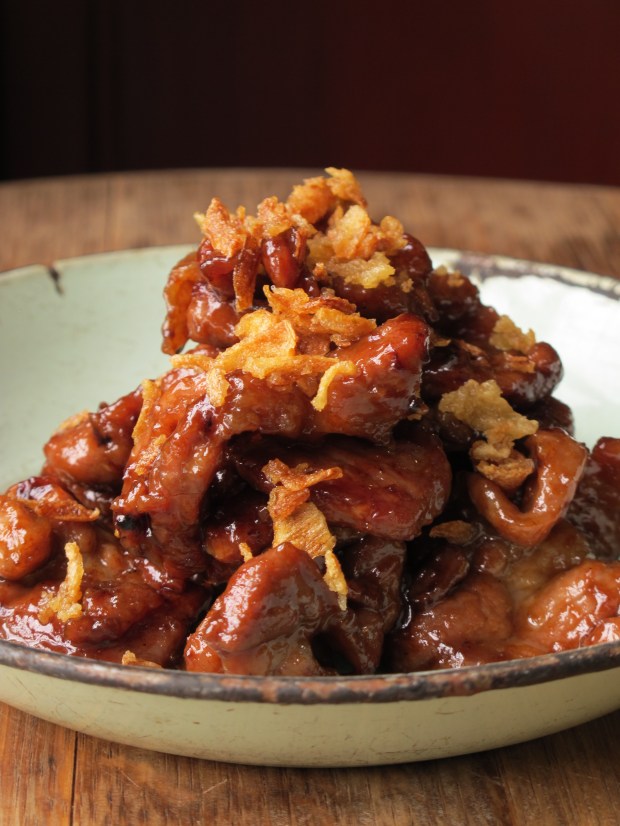
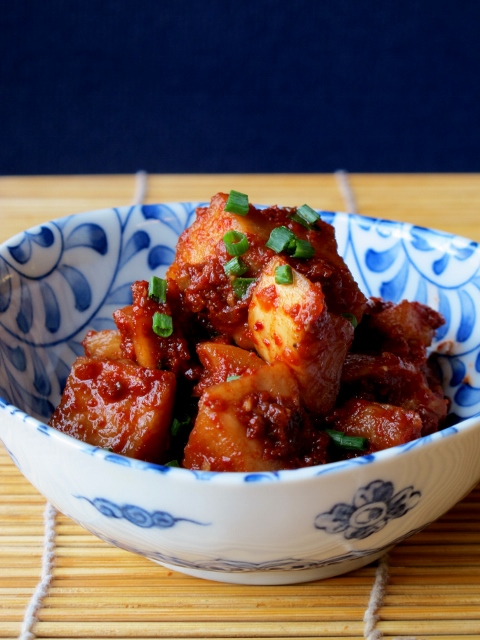
Thai Caramel Pork (Muu Waan)

Caramel is something that most of us associate almost entirely with Western cuisine, more specifically with Western-style desserts, but the use of caramel is, in fact, common in Asian cooking, especially in those countries that formed part of the colonial Indochina region.

In Vietnam, Cambodia, Laos and, to a lesser degree Thailand, the use of caramel sauce is fairly routine and is considered a pantry staple, added to a wide range of dishes. The caramel sauce enriches the colour of the dish and imparts a sweet, smoky undertone. The Vietnamese, in particular, are especially fond of this ingredient. Known as Nước Màu, some of Vietnam’s most popular dishes rely heavily on its inclusion – Bún Chả and Thịt Kho Tàu being prime examples.

Whilst its use is not as prevalent in Thailand, cooking with caramel is not uncommon in Thai cuisine, although typically the flavour is achieved through the caramelisation of palm sugar and not the use of a ready-made caramel sauce. Sweet meat dishes in Thai cuisine are considered the perfect foil to sharper, acidic flavours, as well as creamy coconut dishes – the classic pairing of Shredded Candied Pork, Coconut Rice & Green Papaya Salad (Som Tam) being a case in point. This heavenly balance of flavours is not, however, solely restricted to this classic combination and is something that should be considered when planning any Thai meal. This is where Thai Caramel Pork (Muu Waan) comes into its own.

Similar in flavour to Shredded Candied Pork, Thai Caramel Pork is in fact far quicker to make and is less labour intensive and can be used as an alternative to the shredded variety in the classic combination mentioned previously. Personally I like to pair Caramel Pork with a coconut-based dish such as a Mussaman or a Green curry and a zingy yam (Thai Salad). I am especially fond of serving it with either a simple Fried Egg Salad (Yam Khai Dao) or Waterfall Beef Salad (Neua Naam Tok).

Regardless of what you decide to serve it with, provided you cover the trifecta of Thai flavours (sweet, sour and rich), you’ll be onto an absolute dinner-winner!

For more delicious Thai recipes from the Muddled Pantry please click here

If you would like tips on stocking your Thai Pantry please click here.

Click here for the recipe

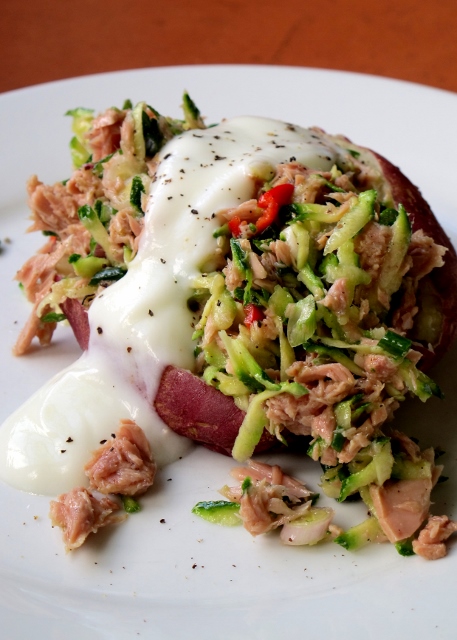
Tuna & Courgette Sweet Potato Pocket

Tuna & Courgette Sweet Potato Pocket

I have never been much of a lunch person, preferring to rather invest my finite enthusiasm for cooking towards crafting a decent dinner.

I suspect that my mid-day apathy is rooted in my years growing up in Malaysia, where lunch was pretty much a no-brainer as it invariably meant one thing: noodles! Beef Hor Fun, wonton mee or Char Kway Teow – a noodle obsession is easy to feed when you live in what is arguably the noodle capital of the world! Alas such lunchtime bliss is now 9000km away and my choices are somewhat less appealing these days. Here in South Africa a ‘sarmie’, pie or a plate of chips are typical lunchtime fare and needless to say, I would rather do without. Nevertheless, a man has still gotta eat so I found myself falling back on old Malaysian habits and having noodles for lunch, albeit nowadays I’ve been reduced to a bowl of a jazzed-up noodles of the 2-minute variety. More recently, however, I have been trying to cut down on complex carbs so even my trusty instant noodle-lunches have been a rarity of late, which is all well and fine, but this has led me back to my initial lunchtime conundrum: what the hell’s for lunch?

For the most part this has meant soup and these days my bowl of choice is minestrone. Since my carb-cutting I’ve eaten a lot of minestrone but as delicious as it is, there is only so much soup a man can sup! Desperate to move back to solid foods I searched high and low looking for a meal that was fast, tasty, filling and, above all, didn’t sabotage my diet. I had almost given up and was about to resign myself to my soupy fate until culinary salvation arrived in the form of a Men’s Health magazine (of all things).

Okay so the featured recipe was pretty basic, but it was ripe with potential. It was exactly what I had been looking for, it was just a tad dull (after all, it was inspired by a Men’s Health recipe), but with a just a few tweaks I knew I was on to a winner! Firstly, I added some coarsely grated baby marrow (courgettes) into the mix, then some finely diced fresh red chilli and red onion and everything was topped with a dollop of plain fat-free yogurt and a crack of pepper: the perfect low carb/high protein lunch in under 5 minutes! With my preferred noodle-lunch still 9000kms away, this sounds like a near-perfect lunch to me.

Click here for the recipe

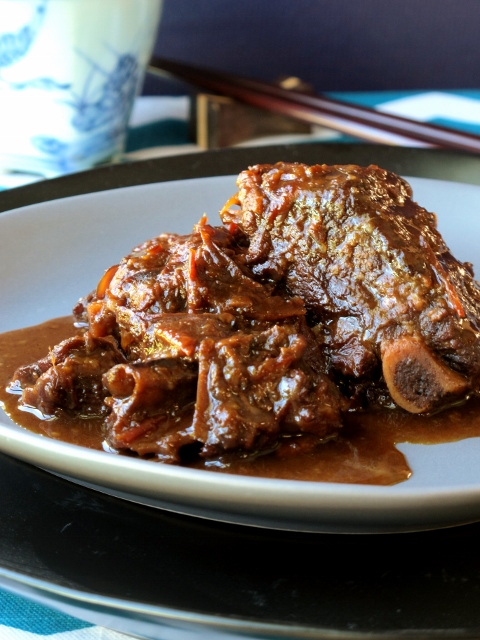
Sticky Beef Short Ribs

Sticky Beef Short Ribs

If I had to pick a favourite cut of beef, it would simply have to be short ribs; cheap, tasty and meltingly tender, I just can’t get enough of them.

The perfect marriage between meat, bone and fat, short rib is my go-to cut of beef for whenever I am doing a long braise, as it is perfectly suited to being cooked for extended periods. Whether it’s for a spicy Mussaman Curry, a comforting bowl of Beef Phở or a simple cider braise beef, short ribs works a treat with just about any style of cooking, so long as it is afforded enough time to work its magic.

Which brings me to this delectable dish! Robustly flavoured and so tender you can literally suck the meat off the bone, Sticky Beef Short Ribs is a great way to prepare this special cut. Although the dish has all the hallmarks of a classic Chinese style braise, the addition of Korean Soybean Paste (doenjang) does muddle the waters somewhat, resulting in a dish that is equally suited to both a Chinese or Korean spread. If you can’t source any doenjang, regular Chinese Bean Sauce would suffice, or, if you wanted to add a Japanese twist to the dish, you can always try some miso. Personally, if you can, I would stick with the doenjang as it adds a distinctly earthy depth to the dish that neither miso nor Chinese Bean Sauce does.  

Note: As with most other Asian braises, this dish is always best if made the day before, but is still delicious if eaten immediately. If you are making the dish in advance then it is best not to reduce the sauce immediately, but rather wait until you are going to eat it to do so.

Click here for the recipe

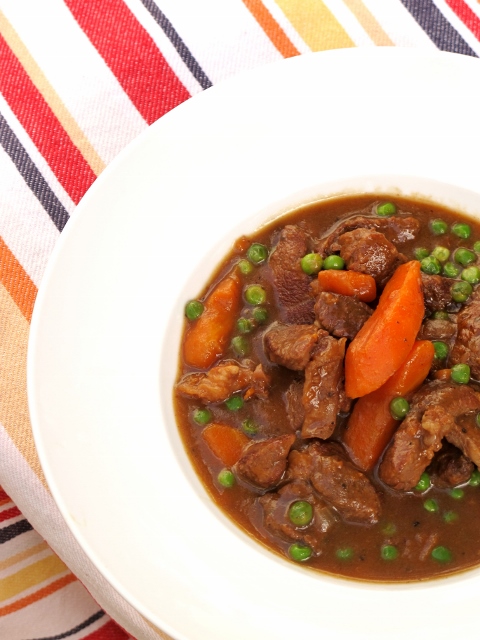
Idaho Stew (Beef Coffee Stew)

Beef Coffee Stew

It was only when I finally moved to Cape Town to be with my partner that I realised I had, in fact, moved in with my own private flavourphobe.

From the very first meal I made us, it was abundantly clear that any thoughts I may have been harbouring about bringing about instant flavour-reform to his palette were a complete waste of time. His tastes preferences were set and I would simply have come to terms with the fact that there wasn’t going to be a belacan-epiphany or a glorious moment of garlic-redemption on the immediate horizon. Regardless how I felt about it, I had made my proverbial table so, for now at least, I was just going to have to eat at it.

For the first few months I dutifully made the plain dishes he enjoyed, but like all good spouses I was really doing what we do best – biding time. An errant garlic clove here, an extra splash of Worcestershire sauce there, little by little I tested the waters and after a while I began to introduce new dishes for his consideration. Some of these offerings were more successful than others, some were downright disasters, although with hindsight the roasted lamb with anchovies was particularly ill considered!

And then I discovered the recipe for this incredible stew.

On paper Idaho Stew fit the bill perfectly; it was a simple, old school beef braise with one small twist – it had coffee in it! It may seem minor now, but please remember that, culinarily speaking, South Africa was a very different place back in 2000. Back then the mere notion of sushi was downright provocative and the thought of cooking a savoury dish with coffee was considered, at best, daring to most South Africans (let alone my dearest flavourphobe)! So yes, back then this humble stew was a risk, but I had to try it, lest I be condemned to making sausage, peas and mash for the rest of my life.

So one night I bit the bullet and dished up my ‘daring’ new stew for dinner. With baited breath I watched as he eyed my latest offering with understandable suspicion. “What is it?”, he asked. “Oh, nothing weird, just a stew” I said, in what I hoped was my most casual voice. “Hmm, okay”, came the reply. Clearly he wasn’t convinced, perhaps the lingering trauma of that damn anchovy lamb was playing on his mind. In spite of his obvious suspicions he took a bite, albeit tentitively and after a moment of furrowed consideration he took another, then another – the stew was hit! It was only once his plate was cleared that I dared divulge the contentious ingredient.

“Coffee? Really? You can’t taste it”.

Wow, he was taking this surprisingly well.

“You can definitely make this again”.

Oh, sweet success!

“But next time may I have it with rice and not mash?”.

Sigh. Okay, so you’re still a freak, but I’ll take the win.

To this day Idaho Stew remains a firm favourite in his limited pantheon of acceptable meals and I still make it often, although he normally refers to it as “his coffee stew” suggesting a secret revelry in the kudos of his expanded palette. These days I usually have a couple of handy portions of this stew in the back of the freezer which I whip out for my partner when we have guests and the menu isn’t to his taste. Unfortunately, this seems to have given his much loved “coffee stew” a bad rep as one of “Brian’s meals”, which is, frankly, simply a byword for dull.

Nothing could be further from the truth! This rich stew is chock full of flavour and should appeal to the whole family…whether or not you dare to tell them that the secret ingredient is coffee is, of course, entirely up to you!

Click here for the recipe
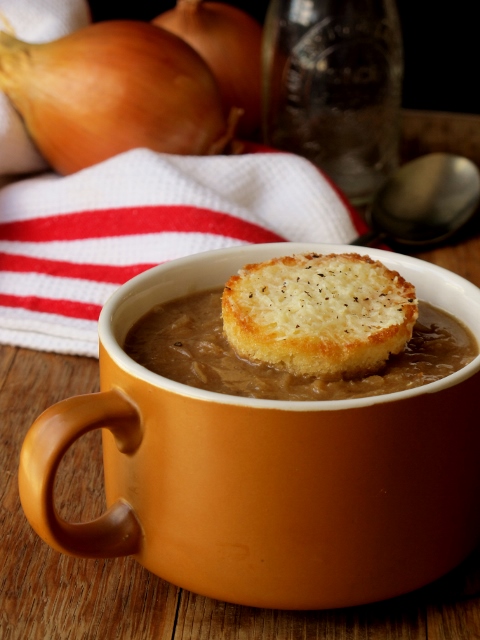
French Onion Soup

French Onion Soup

We’ve all been there – you’ve got nowt in your pantry other than a few onions, a stick or two of butter and half a bottle of wine in the fridge? Believe it or not, you have virtually all the ingredients necessary to whip up a true classic – French onion soup!

A tragically maligned stalwart of French cuisine, onion soup is a relic of 80s bistro fare that most of us are simply just too cool to admit to liking these days. Once considered the epitome of a classic soup, this wonderful dish has been woefully neglected in recent years; a travesty that bares testament to the fact that even the greatest dishes can eventually fall out of favour. Food fads and fashions come and go, but French onion soup deserves so much more and is, finally, enjoying somewhat of a revival and is being appreciated for the old school classic that it is.

So why, oh why is a good French onion soup still so hard to come by these days?

Sadly for what it lacks in fancy ingredients, French onion soup demands in effort and undivided attention, which is probably why a good bowl of this sweet and sour delight is so difficult to find. Simply given the sheer amount of time needed to diligently ‘guard’ your onions against burning, I sometimes doubt making this soup is always compatible with the rigours of a modern commercial kitchen and is, perhaps, more suited to home cooking. Not that I want to put you off, but making good French onion soup is the culinary equivalent of watching paint dry and should only be made when you’ve got the time to do it properly, without any distractions. After all, like so many French classics, onion soup is about transforming the humble into the divine and if that was meant to be easy, it simply wouldn’t be French.

Click here for the recipe

Kkakdugi 깍두기 (Cubed Daikon Kimchi)

Kkakdugi 깍두기 (Cubed Daikon Kimchi)

I have an unholy passion for kimchi and I’m not ashamed to admit it! I simply can’t get enough of this spicy Korean delight and it seems I am not alone. Some of my most popular posts to date have been kimchi related, so I thought it was about time I fed our collective obsession and posted another kimchi recipe. So this time around, I’m making one of my favourite types of kimchikkakdugi or cubed daikon kimchi.

Perhaps second only in popluarity to the almighty mak kimchi, kkakdugi is a great addition to any Korean dining experience. As you would expect with any type of kimchi, this version of the Korean staple is wonderfully piquant and highly addictive; though unlike most others, daikon kimchi has a delightful crunch and crispness to it which helps temper the spiciness of the chilli powder.

Personally, I find the process of making kkakdugi marginally less involved than mak kimchi and the fermenting period is also a little bit shorter, meaning you don’t have to wait quite as along to tuck into your kimchi! On the downside, kkakdugi doesn’t seem to fair as well as other kimchis in terms of its shelf-life, however, this may have more to do with my lack of technique and experience than a shortcoming of the dish!

With regard to technique, making any sort of kimchi is a matter of trial and error. Whilst the core process for making kimchi remains similar for each variety, each version has its own quirks and it may take a few attempts before you end up with a kimchi that suits your own tastes and preferences. Making the perfect kkakdugi has, up to now, been particularly vexing for me as I often find the kimchi comes out too watery and the daikon too limp. I have now taken to draining off the excess water as the kimchi ferments and I have also stopped peeling my daikon – both these seemingly minor tweaks to the process has resulted in a far superior end result (at least in my opinion).

For more Korean recipes from The Muddled Pantry, please click here

For tips on stocking a Korean Pantry, please click here

Click here for the recipe