Main Meals

Lai Yao Kei 奶油鸡 (Malaysian Butter Chicken)

Butter Chicken, but not as most of us know it!

Now obviously I’m a tad biased, but when I fancy some Butter Chicken it typically isn’t the Indian variety I’m hankering after. More often than not, what I’m really craving is actually something altogether different.

Indeed, Lai Yao Kei (Malaysian Butter Chicken) is about a million miles away from what most of us imagine when we think of Butter Chicken. In fact, I’d go so far as arguing this wonderful Malaysian dish, is in a league of its own. Unlike the oft mangled classic that is Indian butter chicken, the Malaysian version is an altogether different beast.

Unlike the Indian alliteration, there are no overnight or penetrative marinates here. Instead, flavoured morsels of chicken are ready for the deep-fryer in less than an hour, and smothered in a super quick creamy aromatic sauce. Infused with the unmistakable aroma of fresh curry leaves, and spiked with the heat from fresh chilies, the sauce itself is actually very simple and comes together in minutes.

Though you’d think the butter would be the star of the show here, it is actually the evaporated milk that steals the limelight. Admittedly, evaporated milk is probably the last ingredient you’d expect to find in a savoury sauce, but trust me, it works a treat and will blow your mind!

To discover other delicious Malaysian recipes from The Muddled Pantry, please click here

Click here for the recipe

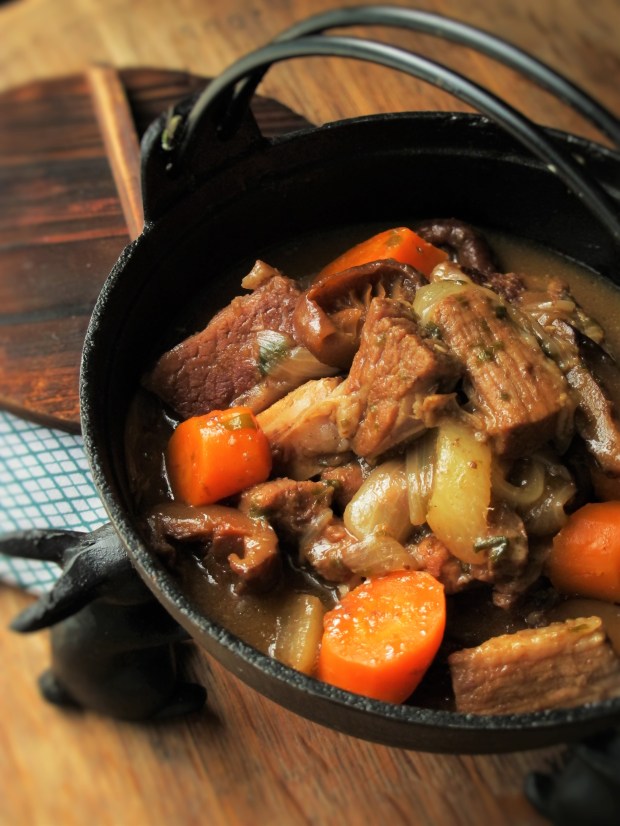
Galbi-jjim 갈비찜 (Korean Beef Short-rib Stew)

Winter is almost upon us here in South Africa, and with that fresh North-westerly blowing through the valley, comes the knowledge that it’s time to start thinking about bowls of stew in front of the fireplace again.

Unlike most people I know, I revel in colder climes, loving the darker days and promise of icy rains. With that in mind, it’s hardly surprising to know that I enjoy nothing more than spending such days fussing over a bubbling pot of hearty concoctions. Epitomising winter food for so many of us, the humble stew is perhaps arguably the most universal form of cooking. Across the globe, from Inuit blubber stew to the Seychellois fruit bat civet de chauve souris, almost every culture has a stew or two in their collective repertoire.

Though typically regarded as fermenters and grill masters, Koreans are no exception with an array of stews designed to get them through their harsh winters.  Dak-dori-tang (spicy chicken) and kimchijjigae (pork & kimchi) are both classics examples and a bowl of either would warm you right up. Their spicy nature, however, isn’t to everyone’s taste. Traditionally milder in flavour, galbi-jjim is no less hearty, but without the heartburn.

Sweet, rich, and savoury, galbi-jjim is traditionally made with beef short ribs, which are braised till fork-tender and the beef has rendered its flavour into the sauce. Simply served with a bowl of steaming rice and some aged mak kimchi on the side, this stew is a cure for even the darkest winter-blues.

It may be true to say that both dak-dori-tang and kimchi-jjigae ignite a fire in your belly, but equally galbi-jjim is like finding a hot water bottle at the bottom of a chilly bed.

Now to my mind, that’s my ultimate winter-bliss – Korean-style.

For more Korean recipes from The Muddled Pantry, please click here.

For tips on stocking a Korean Pantry, please click here

Click here for the recipe

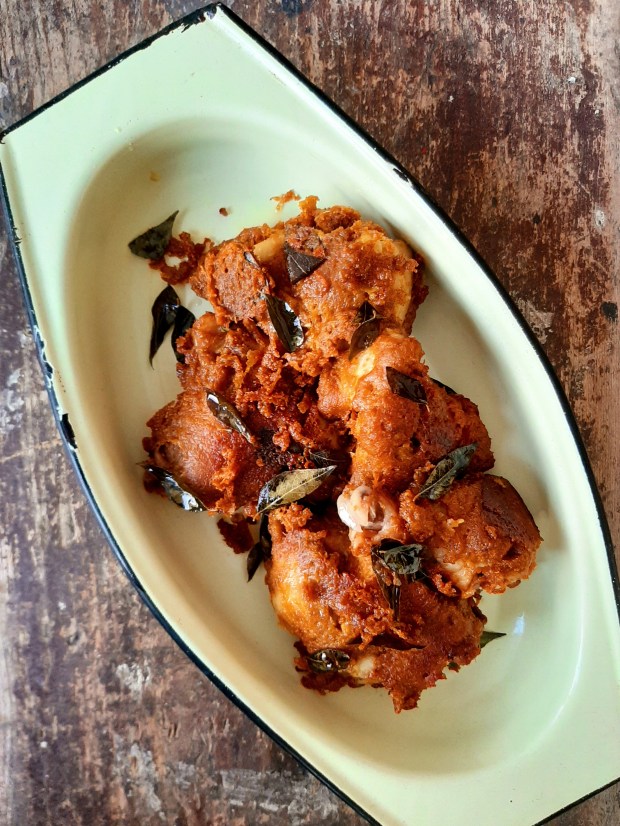
Ayam Goreng Berempah (Spicy Malaysian Fried Chicken)


For better or worse, I have recently found myself an avid fan of deep frying.

In the space of a Lockdown I have gone from fretting about the obvious detriments of cooking this way, to deep frying with rather worrying abandon! Battered sausages, onion rings, and of course, an attempt at D.I.Y. KFC – all have found their way into my sizzling cauldron…and onto my ever expanding hips. Of course, the best part about my newfound love of fried foods is that I can finally bring myself to make some of my favourite dishes at home – specifically, Ayam Goreng Berempah.

Often served alongside nasi lemak and drenched with sambal goreng, this spicy deep fried chicken dish is a crispy and irresistible delight. Marinated overnight in a heady blend of spices and fragrant curry leaves, the chicken is literally bursting with flavour. Unlike many other deep fried chicken recipes, ayam goreng berempah‘s marinate actually doubles up as the batter, meaning less mess!

The “secret” to getting the chicken’s crust crispy is the addition of cornflour into the mix. It’s important to get the ratio between the wet and dry ingredients correct – too wet and the batter/marinate may not remain adhered to the chicken when fried. Personally I like to give my marinated pieces a second dredging of cornflour, a couple of minutes before cooking – just in case! Remember to add a few fresh curry leaves to the sizzling oil beforehand to infuse it with extra aroma and flavour.

Simply irresistible!

Note: it is absolutely vital that the oil not be too hot, as it will burn the crispy coating long before the chicken pieces are cooked through. Ideally you want the temperature to be around 165 to 175°c. It is also important that the meat is at room temperature before cooking.

To discover other delicious Malaysian recipes from The Muddled Pantry, please click here

Click here for the recipe
Nasi Lemak (Malaysian Coconut Rice)


It perhaps goes without saying, but we Asians do love our rice. From fried to steamed, fermented to ground; we work everyday miracles from this most humble grain.

Naturally my native Malaysia is no exception; in fact, in addition to an array of odes to rice, we have even concocted rice dishes of every colour and hue, covering the spectrum from a mellow yellow all the way to an alarming blue. The variety and choice are, frankly, dizzying. Nevertheless, ask a Malaysian what their favourite rice dish is and the most likely answer would be – nasi lemak!

Most commonly associated with breakfast, nasi lemak is arguably the nation’s favourite way to start the day. Fragrant with heady aromatics such as pandan leaf, this coconut enriched rice is the perfect soothing foil to the spicy condiments which are traditionally served alongside it.

At its most basic, nasi lemak bungkus (take-away) comes portioned into small mounds of rice, which are then topped with either a prawn, egg, or ikan bilis (dried anchovy), sambal. Each portion is then expertly wrapped up in a banana leaf and magicked into a three-sided dome – making for the ultimate Malaysian breakfast on-the-go. Aside from its simplistic bungkus variety, nasi lemak can also be an altogether extravagant affair. Served up each morning to queues of customers, a good nasi lemak place comes with a multitude of side dishes, from the classic beef rendang to assam prawns, and almost everything else in-between!

Regardless of the side dishes available, nasi lemak is almost always served with half a boiled egg, sliced cucumber, crunchy peanuts and a generous dollop of sambal goreng.

20200517_141216

Nasi Lemak with the basics: sambal goreng, peanuts, boiled egg & sliced cucumber

Substitutes: Pandan is scarce outside Asia, and although it can be found in some major cities around the world, it is still not widely available to most of us. In the absence of fresh pandan, there are “essences” you can use instead – at a push these are actually fine, though fresh is always best. Unfortunately there is no substitute for pandan, so if you can’t source either, but still want to make nasi lemak, please do. Just omit the pandan altogether and use the galangal and lemongrass instead.

Note: In this post I’m focusing solely on the basic nasi lemak recipe, but if you would like to know more about what else to serve nasi lemak with, please follow the links to my recommendations at the end of the recipe.

To discover other delicious Malaysian recipes from The Muddled Pantry, please click here

Click here for the recipe
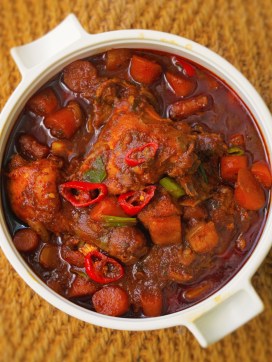
Dak-dori-tang 닭도리탕 (Korean Spicy Chicken Stew)

North or South, Koreans share a universal love for spicy food, and it doesn’t get much more fiery than this hearty stew.

Dak-dori-tang (spicy chicken stew), also known as dak-bokkeum-tang, is a perennial Korean classic, and though the recipe varies across the peninsula it is almost always both fierce and comforting at the same time. Traditionally made from a whole chopped chicken, onions and potato, the recipe can be adapted to your tastes and needs. Though skinned chicken breasts can be used, I personally prefer using boned thighs – they hold up better against the robust sauce, and don’t tend to dry out during the intense cooking process. With regards to the vegetables, again the recipe can be modified to include almost anything you have to hand: carrots, daikon, leeks – all make excellent additions.

Though classified as a stew, dak-dori-tang is actually more of a braise as the liquid is reduced over a high heat, leaving you with a thick and spicy sauce. As the cooking time is quite short (about 30 minutes), it is best to par-cook the harder vegetables before adding them to the sauce. If you opt to use bone-in chicken, it is important to use equal size pieces, making sure that they are well-browned beforehand and you adjust the cooking time accordingly.

Dak-dori-tang 닭도리탕 (Korean Spicy Chicken Stew)

Dak-dori-tang made with chicken pieces on the bone.

Although spicy by nature, dak-dori-tang is no less delicious when made slightly milder, if preferred. Despite their volcanic appearance, Korean chili powder (gochutgaru) and chili paste (gochujang) are actually not anywhere near as hot as they look, making it is quite easy to adjust the dish’s heat without being at the expense of flavour. They actually add a wonderful earthy, smoky undertone, and are definitely worth a trip down to your nearest Asian Supermarket. Though generally quite expensive, both have a very long shelf-life and if you plan to make Korean food they are essential Pantry items. Keep an eye out for Chinese brands as these are often considerably cheaper than their Korean counterparts, with no discernible difference in taste. On that note, a word of warning: under no circumstances should you substitute gochutgaru with any other type of chili powder. Anything else will be way too hot and will undoubtedly be the ruin of your dinner.

Disaster awaits all who are even tempted to try…

For more Korean recipes from The Muddled Pantry, please click here.

For tips on stocking a Korean Pantry, please click here

Serve with: freshly cooked white rice along with a select of banchan (Korean side dishes) – I suggest some simple stir-fried cabbage and, of course, a generous portion of mak kimchi!

Click here for the recipe

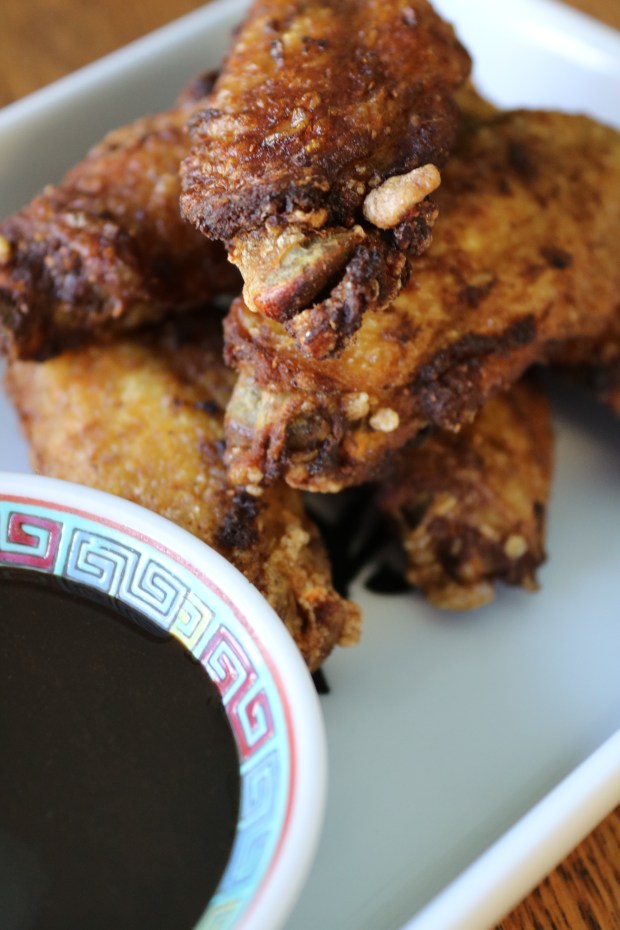
Inche Kabin (Nyonya Fried Chicken)

A delectable Nyonya classic, Inche Kabin will have you licking your fingers and asking for more! Deep fried chicken morsels, marinated in a thick coconut and spiced rub, Inche Kabin is bursting with flavour and always goes down a treat.

Though not personally au fait with the origins of Inche Kabin, the reigning queen of Nyonya Cuisine Pearly Kee, refers to the dish as lipstick chicken and speaks to its importance in Nyonya culture. Often served when presenting debutantes to the society, these bite-sized pieces of chicken were the perfect option to keep the young ladies feed, allowing them to maintain their poise and dignity whilst nibbling on tasty snacks. After all, heaven forbid your future wife be seen chewing in public! Oh how the world has changed…And as to why it’s also known as lipstick chicken? I’m still not sure. It may well be poetic license, but I can only surmise that the residue of oil from the deep fried chicken upon the lips has something to do with it. I guess glossy lips have always been in vogue, even if its just a bit of grease from too much Inche Kabin!

As with all deep fried chicken, the key to a good Inche Kabin is, rather unsurprisingly, the frying. Three times seems to do the trick, resulting in a crispy crust of spices. Traditionally chopped up chicken legs are the cut of choice, but I also like to use chicken wings for the recipe. Though obviously not as meaty as the leg, the wings are nonetheless delicious and not prone to drying out. Either would work, its really up to you.

Another key component to the dish is the dipping sauce. Never served without it, the simple piquant sauce adds just enough ‘zing’ to cut through the spice crust, making the Inche Kabin even more irresistible!

To discover other delicious Malaysian recipes from The Muddled Pantry, please click here

Click here for the recipe

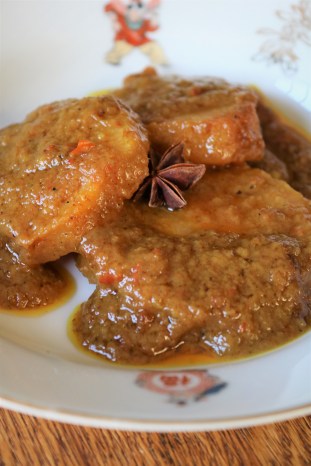
Kari Nenas (Malaysian Pineapple Curry)

Kari Nenas (Malaysian Pineapple Curry)

From the heady spiced tagines of Morocco, to the British classic of roast pork with apples, almost nothing divides diners as much as the testy subject of fruit in cooked dishes.

Though their inclusion is widespread throughout some of the world’s greatest cuisines, there are many among us that nevertheless rile against it. To those, the combination of fruit and savoury is tantamount to flavour blasphemy! Now I’m not here to convert you (what’s the point, you’ve probably searched “Pineapple Curry” on the internet, so you are likely already a fan!), but when paired correctly, fruit can be a masterstroke ingredient in many a dish. Whilst I have a couple of fruity dishes that qualify as firm family favourites, one dish in particular holds a very special place in my heart: Kari Nenas.

The first time I had this wonderful dish was when I was a child at my youngest uncle’s first wedding. Set deep within the verdant Malaysian jungle, the wedding took place in an achingly idyllic kampong (village). And though I am a little vague on the nuptial itself, the one thing I certainly do remember was the feast that followed. Laid out along the worn wooden floors of the traditional stilted house, was a resplendent collection of Malay dishes, all lovingly prepared by the ladies of the house. All the great classics were there – beef rendang, kari kapitan and, of course, lots of roti jala to mop it all up! I recall taking my place on the floor, ready to tuck in, when I noticed the dish right in front of me was altogether unfamiliar. Yes, it was the Kari Nenas. A fussy eater at the time, I was more than a little hesitate to try it, but after some prompting from those around me, I acquiesced and tried it. I was immediately hooked! Enriched with creamy coconut milk, the dish was an irresistible mix of sweet and sour. Delicious in of itself, the dish also brought harmony to the multitude of flavours on offer. In fact, this was quite possibly the first time I became aware of balance as a concept in relation to flavour: quite a moment in a food blogger’s life!

Unlike many dishes with fruit in them, Kari Nenas is all about the pineapple. Typically fruit is added to compliment meat and/or sweeten a sauce, but in this case the fruit flies solo. The secret of its success lies in the combination of coconut milk and tamarind, both of which cut through the sweetness of the fruit. A slight hint of chili rounds off the dish perfectly.

Quick and easy to make, kari nenas isn’t really a curry to be eaten on its own, but rather as part of a larger spread. As I mentioned previously, it goes especially well with beef rendang, lots of sambal belacan and perhaps even with a simple green bean omelette and some rice.

To discover other delicious Malaysian recipes from The Muddled Pantry, please click here

Click here for the recipe

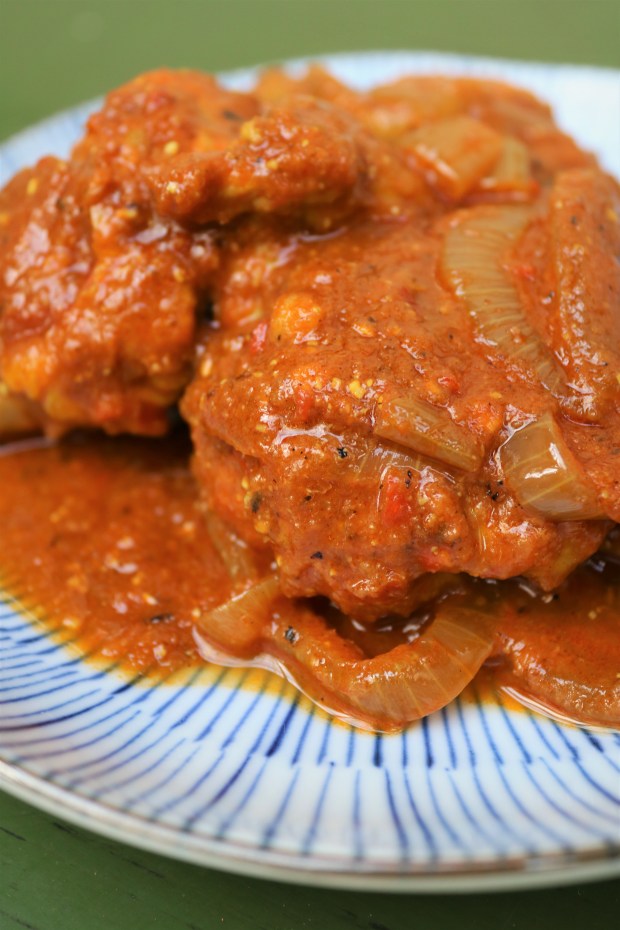
Ayam Masak Merah (Malaysian Red Cooked Chicken)

As a child I wasn’t a great fan of spicy food, in fact I loathed it. Having grown up in Malaysia this presented a very real challenge, especially for my grandmother. The undisputed Queen of the Kitchen, my amah was always keen to entice me over to the spicy-side and did so through a protracted period of gentle assimilation, incrementally introducing my tender palette to the delights of one of my family’s greatest obsessions: chili.

One of my earliest memories of eating around the family dining table was watching as the Ghani men ate raw chili padi dipped in hecko sauce (it was always the men, the woman seemed to have more sense). Egged on by brotherly bravado, my father and uncles would pop these searing missiles into their mouths, chewing and grunting in apparent pleasure, all the while wiping their brows with handkerchiefs damp with sweat. This would go on until the large plate of chillies was laid bare and their stomachs churning in revolt. Apparently, this is what my amah was coaching me for, an adulthood of chili padi and agonising trips to the loo! It was a terrifying prospect to one so young, but thankfully she started me off easy and that is how Ayam Masak Merah become a childhood favourite of mine!

Despite it’s rather alarming name, Masak Merah (red cooked) is actually one of the milder dishes amongst the pantheon of Malaysian curries and was the perfect vehicle to get me started on, what to be, my love affair with all things spicy. Unlike most other Malaysian curries where the use of coconut milk is ubiquitous, Masak Merah is tomato-based, hence the name. Reliant on tomato rather than chili for its colour, the dish is fiery red but without the burn associated with its devilish hue. As it is still ostensibly a curry the use of chili is a prerequisite, but the quantities of such can be reduced without losing the appeal of the dish, making it an excellent option for those adverse to too much heat, especially children.

Quick to make and utterly delicious (even when eaten on the day it’s cooked), my fondness of Masak Merah followed me long after I have graduated to spicer dishes. When I moved to the UK it was one of my favourite tastes-of-home, and whenever I came back from a holiday in Malaysia my bag was always loaded with packets of Brahim’s Masak Merah sauce! Like most expat Malaysians I never bothered to learn how to make our favourite dishes, especially when the quality of readymade sauces were so widely available. Sadly, upon moving to Cape Town, my trips back to Malaysia diminished and with it my supply of those handy packs of Brahim’s. As is the case, there was only one thing for it: I would have to learn to cook Masak Merah myself!

Finding a decent recipe for this beloved childhood dish was surprisingly hard and almost all of my previous attempts fell woefully short of expectations. Cans of tomato soup seemed to dominate the recipes, but as far as I could recall I’d never seen a tin of Heinz in amah’s cupboard, much less in her Masak Merah! Disappointed, I did what every sensible Malaysian does and turned to the family WhatsApp group. Of course, they didn’t disappoint, and the recommendations came flooding in almost immediately. Initially most of these seemed similar to the recipes I’d already tried, but then came the motherload, a message for my aunt, Rohani Jelani. One of Malaysia’s preeminent food writers and cooks, hers was the Masak Merah I had been hoping for and it didn’t disappoint! Simple, both in method and ingredients, this was Malaysian home cooking at its best, and with just a few tweaks was the closest I’ve come to finding a recipe that matches my recollection and expectations. Amah would be proud.

Note: Though not traditional, you could also use jointed chicken wings. Simply dust the wings in seasoned flour, dip in egg and then coat in flour. Deep-fry before adding to the sauce. Reduce to its nice and sticky. Delicious!

To discover other delicious Malaysian recipes from The Muddled Pantry, please click here

Click here for the recipe

Cantonese Beef Steak

Some days you just wake up with a hankering for a really nice bit of steak, but if you are anything like me, that beefy craving is usually for steak of an altogether different variety: Cantonese beef steak!

Growing up in Penang in the early 80s the only time I really ate steak was at Chinese restaurants, where it was invariably prepared Cantonese-style. It is, therefore, hardly surprising that I’ve only recently begun to appreciate Western-style steak. Unnaturally tender and served with an addictively sweet soya-based pepper sauce, Chinese beef steak was undoubtedly the steak of my childhood! Of course, like all middle-class families in 80s  Penang we occasionally ate at the Eden

Steak House on Hutton Road, with its glorious coral décor and outlandish flourish of curly parsley (as children we were unconvinced that the parsley was, in fact, edible!). Looking back, we actually used to visit the Steak House quite often, but strangely enough I don’t recall ever actually ordering the steak. I’m pretty certain my father might have had it on occasion, but that was “dad food”. At any rate, who wanted steak when you could have lobster thermidor and prawn cocktail instead? This was, after all, the 80s…

So what makes a piece of steak Chinese?

The first thing that makes this dish such a Chinese classic is the sauce. Glossy and rich, this sauce is the perfect mix of sweet and peppery goodness – this isn’t a sauce for the faint of heart! The Worcestershire sauce adds spiced depth, whilst the tomato sauce imparts a hint of colour and extra body once everything has been reduced down to a sticky, gooey sauce.

Secondly (and most importantly) is the texture of the meat. Marinated in a batter made with corn flour, eggs and Bicarbonate of Soda, the beef is rendered meltingly tender – almost to the point that the texture of the steak no longer resembles meat. This might sound unappealing, but this technique of tenderising meat with Bicarbonate of Soda is fairly widespread in Chinese cooking where the quality of the meat is not always guaranteed. As unpalatable as it may seem, the use of Bicarb goes a long way in making the Chinese food you make at home actually taste like the cuisine you are striving to emulate. Authenticity isn’t always pretty, especially when making Chinese food!

For more Chinese recipes from the Muddled Pantry, please follow the link here.

For tips on stocking a Chinese pantry, please follow the link here.

Click here for the recipe

Gimbap 김밥 (Korean Seaweed Rice Rolls)

Food is so often about memory and for me gimbap will forever remind me of one thing: icebergs.

It may seem like an unlikely association to have with this Korean staple, but it’s hardly surprising given that first time I had gimbap I was sailing across an impossibly blue glacial lake in the heart of Patagonia. I watched with awe as an iceberg the size of a double-decker bus floated by like a feather on water, all the while merrily munching on my gimbap packlunch. It was certainly a surreal experience and one I’ll never forget, both visually and culinarily speaking.

Admittedly Argentina might seem like the least likely place to find gimbap (or kimbap), but our hotel in El Calafate was run by a delightfully un-Argentinian Korean family and they happened to offer gimbap as a packed lunch option. Of course I couldn’t resist ordering it for our planned boat tour on Lago Argentino! At this stage of our trip I was understandably sick of empanadas so I jumped at the chance to try something different. More than that, however, I was intrigued that these Korean expats had deemed gimbap worthy of re-creating in this one-horse town in the depths of Patagonia. It couldn’t be an easy (or cheap) undertaking, so to my mind it most definitely had to be worth ordering!

So yes, Koreans sure do love their gimbap.

With its origins found in the Japanese occupation of Korea, gimbap literally translates to seaweed (gim) rice (bap) and is Korea’s answer to sushi (specifically norimaki), but with a few key differences.

The first major departure is the rice. Whilst short-grained rice is used in both, the difference lies in the dressing. Instead of the rice vinegar dressing that is used in Japanese sushi, gimbap rice is seasoned with sesame oil and salt.

Secondly, the gimbap fillings are all pre-cooked which means that gimbap keeps for far longer than sushi does – making it a popular option for picnics and takeaway lunches. Although typically eaten alone, mini-gimbaps are also served as a side dish to the pre-eminent and spicy manifestation of Korean street food  that is ttoekbokki (떡볶이).

Another key difference is the texture of the seaweed wrapping. Although similar seaweed sheets are used in both gimbap and norimaki, the seaweed used for gimbap becomes much chewier as it is typically eaten long after it has been rolled and as such, absorbs the moisture from the rice.

There are really no limits to the variations of gimbap fillings, but generally speaking the most commonly found are sogogi (beef) gimbap (소고기 김밥) and chamchi (tuna) gimbap  (참치김밥). I have included the ingredient lists for both beef and tuna gimbap below. Once the ingredients have been prepared the process for making the rice and assembling the gimbap remains the same regardless of the fillings.

For more Korean recipes from The Muddled Pantry, please click here

For tips on stocking a Korean Pantry, please click here

Click here for the recipe